Home » Building the AI Economy: Saudi Arabia’s Vision and Momentum
Artificial intelligence has become one of the central drivers of economic, technological and industrial transformation worldwide. From the reorganisation of value chains to the optimisation of public services, and from energy and healthcare to smart cities, AI is reshaping the foundations of competitiveness for states and businesses alike. In this global context marked by accelerated digitalisation and intensifying technological competition, Saudi Arabia has positioned artificial intelligence as a strategic pillar of its national modernisation agenda.
Saudi Arabia stands out for having a very young and highly connected population. Over 70% of Saudi nationals are under the age of 35, while around 99% of the population uses the Internet. Social media penetration is among the highest globally, reflecting a society that is highly digitally literate and receptive to online services, platforms, and innovation, particularly among younger generations.
This trajectory is firmly rooted in Vision 2030, launched in April 2016, which sets out the Kingdom’s ambition to build a diversified, knowledge-based economy, driven by innovation and advanced technologies. From the early stages of this strategy, Saudi authorities sought to project a forward-looking technological narrative and to engage with emerging digital trends at the international level. A symbolic milestone in this phase occurred in 2017, during the inaugural edition of the Future Investment Initiative held in Riyadh, when the humanoid robot Sophia was presented on stage and granted symbolic Saudi citizenship, an episode widely covered by international media and interpreted as a signal of the Kingdom’s openness to advanced technologies and global AI debates.
Before 2019, technological and digital governance in Saudi Arabia was embedded within broader national development agendas rather than overseen by a single authority dedicated to data and artificial intelligence. The launch of Vision 2030 in 2016 marked a turning point by positioning digital transformation as a central pillar of economic diversification and public sector reform, integrating objectives related to ICT, e-government and digital infrastructure into long-term strategic planning. Governance during this period relied on sectoral institutions: the Ministry of Communications and Information Technology shaped ICT policy and expanded connectivity, while the Digital Government Authority coordinated the modernisation of public administration, in alignment with the National Transformation Program, a key Vision 2030 instrument aimed at strengthening digital adoption and institutional efficiency. A decisive institutional shift came in August 2019 with the royal decree establishing the Saudi Data and Artificial Intelligence Authority, creating a unified framework to coordinate national policies and standards on data and AI; since then, SDAIA has led the National Strategy for Data and AI and overseen its implementation across government.
In parallel, the Public Investment Fund, established in 1971 and repositioned under Vision 2030 as the Kingdom’s primary engine of economic diversification, has assumed an increasingly prominent role in supporting technology-driven sectors. Through strategic investments in digital infrastructure and artificial intelligence, the Fund has contributed to the development of knowledge-based industries aligned with Saudi Arabia’s long-term economic transformation. This trajectory was further consolidated with the launch of HUMAIN in May 2025 under the aegis of the Public Investment Fund. Conceived to develop the entire artificial intelligence value chain, from data centres and cloud infrastructure to advanced computing capabilities, HUMAIN reflects the Kingdom’s ambition to scale national AI infrastructure and attract international technology partners.
Beyond institutional architecture and flagship initiatives, the rapid expansion of the digital economy provides tangible evidence of Saudi Arabia’s technological transition. By 2024, the digital economy accounted for 16% of the Kingdom’s GDP, up from 15.6% the previous year, underscoring the growing macroeconomic weight of digital activities. The Information and Communications Technology sector generated operating revenues of SR249.8 billion (€56.5 billion), driven primarily by telecommunications, while the sharp rise in ICT imports and the surge in exports and re-exports point to an increasingly competitive and outward-oriented digital ecosystem. This domestic transformation has been accompanied by a parallel effort to shape international digital governance, illustrated by the creation of the Digital Cooperation Organization in November 2020, which positions Saudi Arabia not only as a technology adopter, but also as a convening actor seeking to influence global digital cooperation frameworks.
The development of large-scale data centre infrastructure lies at the core of Saudi Arabia’s artificial intelligence strategy. AI systems depend on substantial computing power, secure data storage and high-performance cloud services, making data centres a strategic national asset. Saudi Arabia has therefore prioritised investments in this area, leveraging its energy capacity, geographic position and state-backed investment model.
The Hexagon Data Center in Riyadh, developed under the leadership of SDAIA, is emblematic of this approach. Presented as one of the world’s largest government data centres, the project is designed to reach a capacity of approximately 480 megawatts (MW) and to host hundreds of government digital platforms. Its objective is to strengthen the resilience, security and performance of national digital infrastructure while supporting the digitalisation of public services. By way of perspective, Saudi Arabia’s existing data centre capacity in 2025 is estimated at around 222–340 MW of active IT load across operational facilities, and numerous new projects, including Hexagon, are either under construction or planned. These developments are expected to push total national data centre capacity well beyond 1 gigawatt by 2030, underscoring the scale of infrastructural expansion underpinning the Kingdom’s digital and AI ambitions.
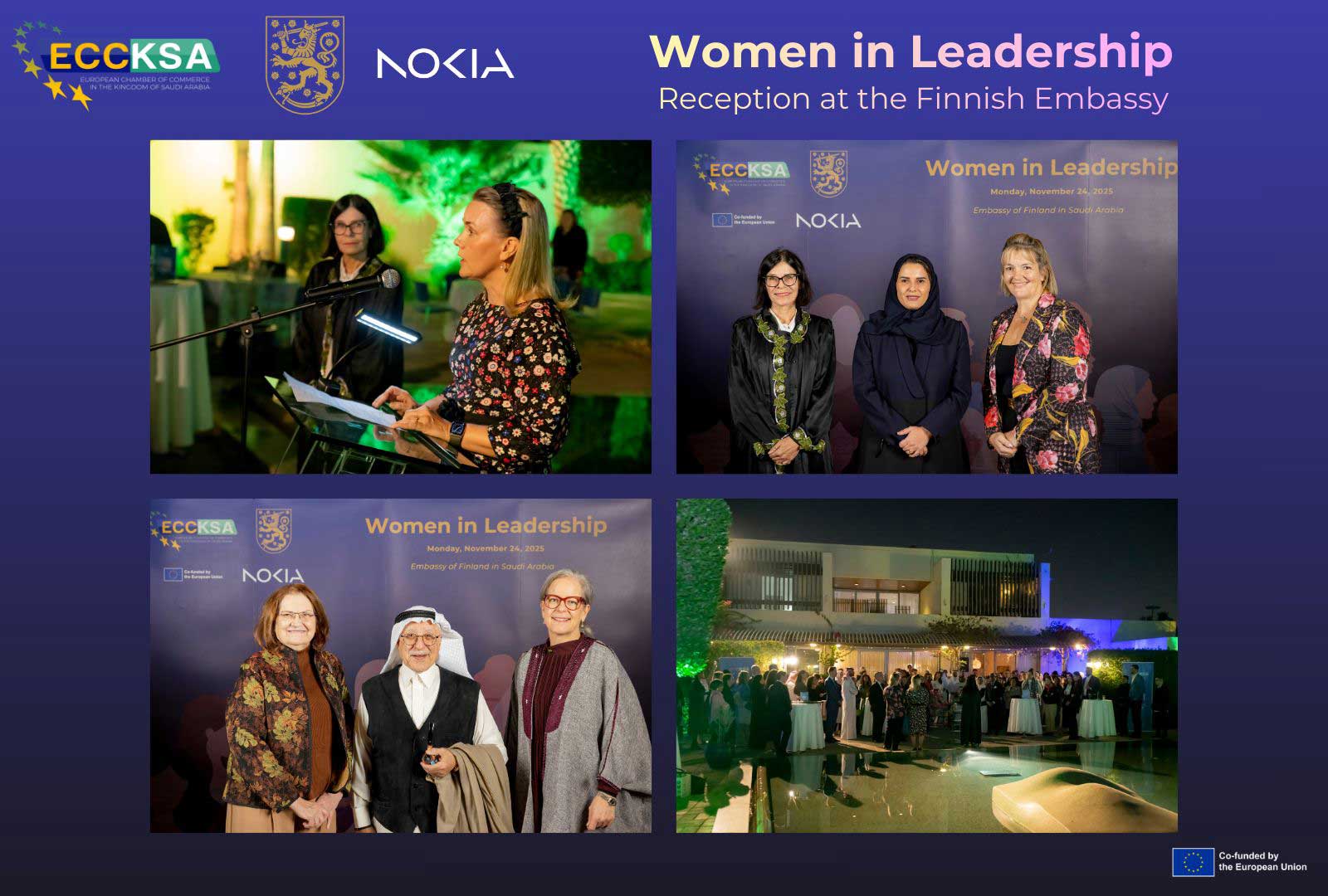
Beyond infrastructure, artificial intelligence is increasingly mobilised as a transversal tool for modernising key sectors of the Saudi economy. Through the National Strategy for Data and Artificial Intelligence, the Kingdom seeks to integrate AI into priority domains such as energy, healthcare, transport, education and public administration, with the aim of improving efficiency, enhancing decision-making and enabling new forms of service delivery. In the education and skills domain, partnerships with international technology firms illustrate this approach, for instance through initiatives led by ECCKSA’s member Nokia in cooperation with international organisations, which focus on digital skills development, AI-related training and the promotion of women’s participation and leadership in the technology sector. Such programmes contribute to building human capital aligned with the Kingdom’s long-term digital and AI ambitions.
In energy, AI applications support predictive maintenance and operational optimisation. In healthcare, data-driven tools contribute to improved diagnostics and system planning. In public administration, AI is closely linked to digital government initiatives designed to streamline procedures and improve service quality. These sectoral applications are underpinned by a broader national strategy that has gained international recognition. In 2024, Saudi Arabia was ranked first worldwide for government AI strategy in the Global AI Index, reflecting the coherence and ambition of its policy framework. Building on this position, initiatives such as HUMAIN signal the Kingdom’s ambition to position itself as a global hub for artificial intelligence, combining large-scale infrastructure, institutional coordination and international partnerships. International observers, including the World Economic Forum, have highlighted Saudi Arabia’s efforts to embed AI within a comprehensive digital governance agenda aligned with Vision 2030.
A third pillar of Saudi Arabia’s AI trajectory lies in the structuring of a national ecosystem supported by international partnerships. The Kingdom has actively pursued cooperation with global technology firms, cloud service providers and infrastructure specialists, recognising that artificial intelligence development is inherently global. In this context, the Public Investment Fund plays a central role in facilitating these partnerships, combining financial capacity with long-term strategic vision. International media coverage has underlined Saudi Arabia’s growing engagement with global technology actors in the fields of AI and data centres, as part of a broader effort to diversify the economy and strengthen technological capabilities.
Events such as LEAP, organised annually in Riyadh since 2022, further reinforce this ecosystem-building dynamic by bringing together policymakers, investors and technology leaders from around the world, positioning Saudi Arabia as a convening hub for discussions on artificial intelligence and emerging technologies. Since its inception, the conference has grown rapidly: the first edition in 2022 drew more than 100,000 participants, the second edition hosted over 172,000 visitors, and by 2025 LEAP attracted more than 201,000 attendees, bringing together more than 1,000 speakers, more than 1,800 global tech brands, and more than 1,900 investors from across the global tech community.. This places LEAP among the largest technology gatherings worldwide, comparable in scale to other major tech events such as VivaTech in Paris, which welcomed approximately 165,000 participants in 2024, and GITEX in Dubai, which similarly targets around 200,000 visitors. The trend since 2022 demonstrates not only LEAP’s rapid expansion in attendance and international reach, but also Saudi Arabia’s success in drawing global tech stakeholders to Riyadh on an annual basis.
This evolving ecosystem also creates significant opportunities for European companies, particularly in areas where Europe holds recognised expertise, such as advanced telecommunications, cloud and data centre engineering, cybersecurity, smart mobility, industrial AI, and digital public services. European firms are already increasingly visible within the Saudi market, including through their participation in LEAP and related technology forums, where they engage with Saudi institutions, investors and local partners. In this context, the European Chamber of Commerce in the Kingdom of Saudi Arabia (ECCKSA) aims to further structure this engagement through dedicated events and the planned creation of a specialised committee focused on artificial intelligence and emerging technologies, reflecting a growing European interest in the Kingdom’s rapidly expanding digital ecosystem.


Membership
Committees
Events
News & Media
Publications
Other
About Us
Membership
Committees
Events
News & Media
Publications
Other
© 2026 European Chamber of Commerce in the Kingdom of Saudi Arabia (ECCKSA). All rights reserved. | V – 4.9