
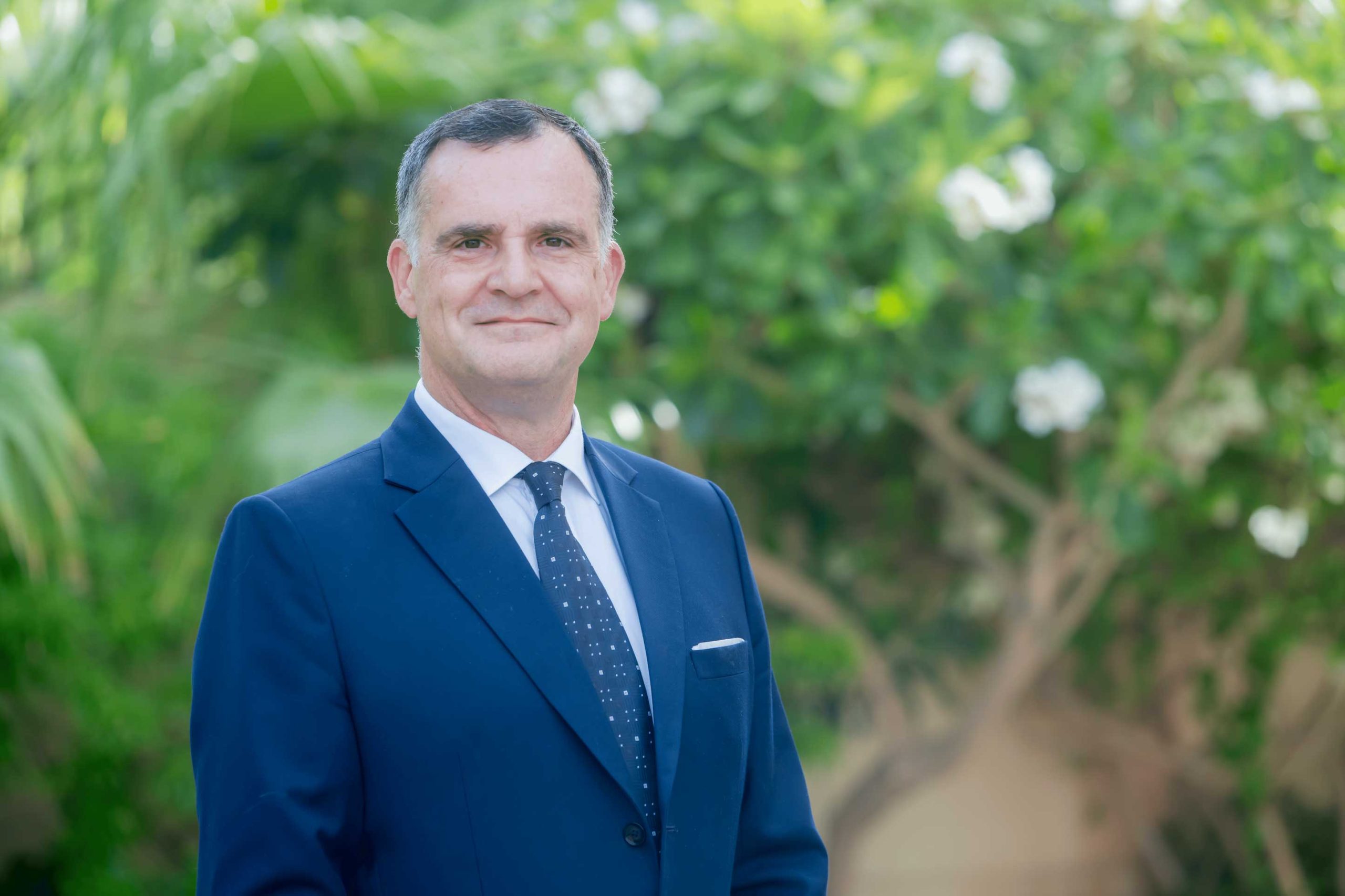
Home » Interview with H.E. Christophe Farnaud, Ambassador of the European Union to the Kingdom of Saudi Arabia, Bahrain and Oman, on EU-Saudi Arabia Relations
Saudi Arabia is the EU’s largest trading partner in the Gulf region, while the EU is Saudi Arabia’s second-largest trading partner overall. As the Kingdom advances its Vision 2030 agenda, the pace of structural transformation across sectors including energy, infrastructure, digital services and manufacturing is creating substantial and sustained demand for European expertise, technology and investment.
In 2025, total bilateral trade in goods and services reached €88.8 billion. The bilateral relationship is underpinned by strong fundamentals: the EU is the leading source of foreign direct investment into Saudi Arabia, holding 29% of total FDI stock, and over 2,500 European companies are currently active across the Kingdom. European businesses are not merely present in this market; they are integral to its development.
On the occasion of Europe Day, ECCKSA is proud to celebrate Europe’s presence, values and economic engagement in the Kingdom of Saudi Arabia. Marking Europe Day in Saudi Arabia is an opportunity to highlight the growing strength of EU-Saudi economic relations and the shared ambition to deepen cooperation between European businesses and Saudi stakeholders. It also reflects the broader momentum of a partnership built not only on trade and investment, but also on dialogue, mutual trust, innovation, sustainability and a common commitment to economic diversification.
The European Chamber of Commerce in the Kingdom of Saudi Arabia is the pivotal bilateral platform fostering dialogue and collaboration between European businesses and Saudi stakeholders. Backed by strong government ties and EU diplomatic support, ECCKSA provides a dynamic business network and facilitates high-level engagement with representatives from Saudi Arabia and Europe.
Saudi Arabia offers significant opportunities across key sectors including energy, infrastructure and digital transformation. However, navigating this market alone can be challenging: regulatory frameworks, business practices and policy developments impact all European companies alike. This is where ECCKSA provides essential support. By consolidating European interests, ECCKSA ensures that businesses are represented, supported and engaged at the highest levels.
To further reflect on this growing partnership, ECCKSA is honoured to feature an interview with H.E. Christophe Farnaud, Ambassador of the European Union to the Kingdom of Saudi Arabia, Bahrain and Oman, on the current state of EU-Saudi relations, the opportunities created by Vision 2030, and the role of European companies in the Kingdom’s economic transformation.
These relations are strong in all fields. We coordinate closely on all major political topics. It is particularly true in the context of the current crisis. The EU condemned very clearly the Iranian attacks against the Kingdom and the other members of the GCC. A series of high level visits and exchanges in the last weeks also allowed us to show solidarity and work on more cooperation to find a diplomatic solution and prepare the next steps of our partnership.
Let me give you another example: last year, the EU officially offered negotiations to establish bilateral Strategic Partnership Agreements (SPAs) with the six countries of the Gulf Cooperation Council (GCC). These negotiations represent a major shift toward deeper, individualized, and comprehensive relationships between the EU and each Gulf nation, complementing existing regional frameworks. A major part of the SPA would cover trade and investment relations bringing therefore substantial value added for our companies established in Saudi Arabia. The bilateral track comes in addition to a possible regional EU-GCC FTA for which we are in an assessment stage with the GCC secretariat.
And, following the historic EU-GCC Summit held in Brussels in October 2024, which was attended by HRH the Crown Prince, we look forward to the second edition which is expected to be hosted here, in Saudi Arabia.
As for the economic ties, the EU is currently Saudi Arabia’s second-largest trading partner.
The volume of EU exports of goods and services has been steadily increasing since 2021, currently stands at a combined trade volume in goods and services of a little over EUR94 billion.
Additionally, around 2,500 European companies operate in the Kingdom, while the EU is Saudi Arabia’s leading foreign direct investor, reflecting the strong shared interests between the Kingdom and the EU.
The breadth of opportunities in Saudi Arabia is extensive due to Vision 2030’s wide-ranging initiatives. Key sectors include transport, energy, manufacturing, tourism, and education.
Transport is a vital sector, both for urban mobility and connectivity across the vast Saudi territory. European expertise is already evident in projects such as the Riyadh Metro, where major European firms were actively involved.
The energy sector is another priority, especially given the global transition to sustainable energy. While Saudi Arabia remains a dominant player in oil and gas, it is also investing heavily in renewables. The EU and Saudi Arabia will further structure this energy cooperation, focusing on the energy transition, sustainability, and green energy initiatives. European companies are well-positioned to contribute expertise in these areas.
Manufacturing also presents significant opportunities. Many European firms supply high-tech equipment to Saudi industries, and their involvement extends beyond trade to include investment and training initiatives.
Education and training are particularly crucial, as the Kingdom prioritizes human capital development. European universities and institutions are fostering closer ties with Saudi counterparts to enhance knowledge transfer.
Further cooperation can be also foreseen in more recently with the emergence of AI and Digital as priority sectors in Saudi Arabia and in Europe.
The EU seeks to strengthen its role as a key partner in Saudi Arabia’s economic transformation.
The EU’s capabilities in advanced manufacturing, engineering, and sustainable technologies areas central to Saudi Arabia’s diversification plans under Saudi Vision 2030, give us opportunities to make progress jointly.
European firms are particularly strong in renewable energy (wind, solar, hydrogen), infrastructure and smart cities, chemicals and advanced materials, this complements Saudi Arabia’s push to move beyond oil in a way that commodity-focused partners (or even tech-heavy but less regulated systems) don’t fully match.
Finally, the EU’s commitment to climate policy and green finance, while Saudi Arabia is investing heavily in hydrogen and renewables, creates a perfect alignment of offer and demand.
The fact that we have a European Chamber here already for 2 years is a testimony of our commitment, of EU companies’ commitment to play a key role in shaping this relationship to the next level.
Notably, it is the first of its kind in the region, highlighting the EU’s strategic focus on Saudi Arabia.
The Chamber’s core function as a business-driven initiative that enhances cooperation between European companies, Saudi businesses, and the Saudi government.
I see it through the activities and initiatives the ECC has taken up since its inception: the organized roundtables on critical sectors such as energy and transport, proving its effectiveness as a bridge for European companies navigating the Saudi market.
Collaboration with Saudi ministries, particularly the Ministry of Investment and the Ministry of Commerce, has been excellent, reinforcing a dynamic approach to economic engagement.
Figure: Invest Saudi Renewable Energy Brochure (MISA, 2024)
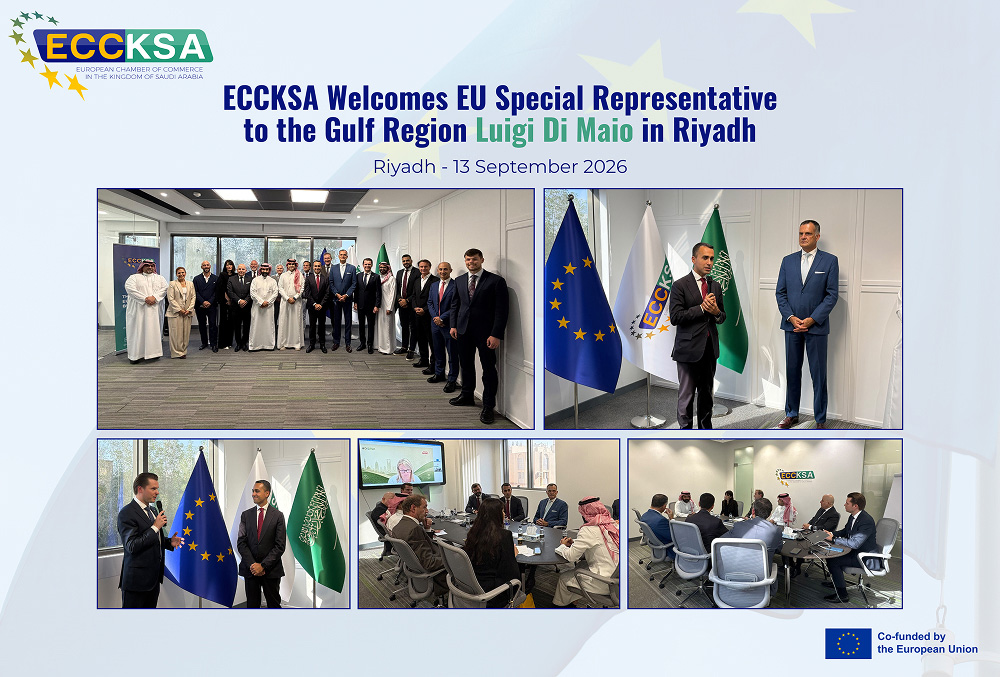
ECCKSA Welcomes EUSR for the Gulf Region H.E. Luigi Di Maio in Riyadh
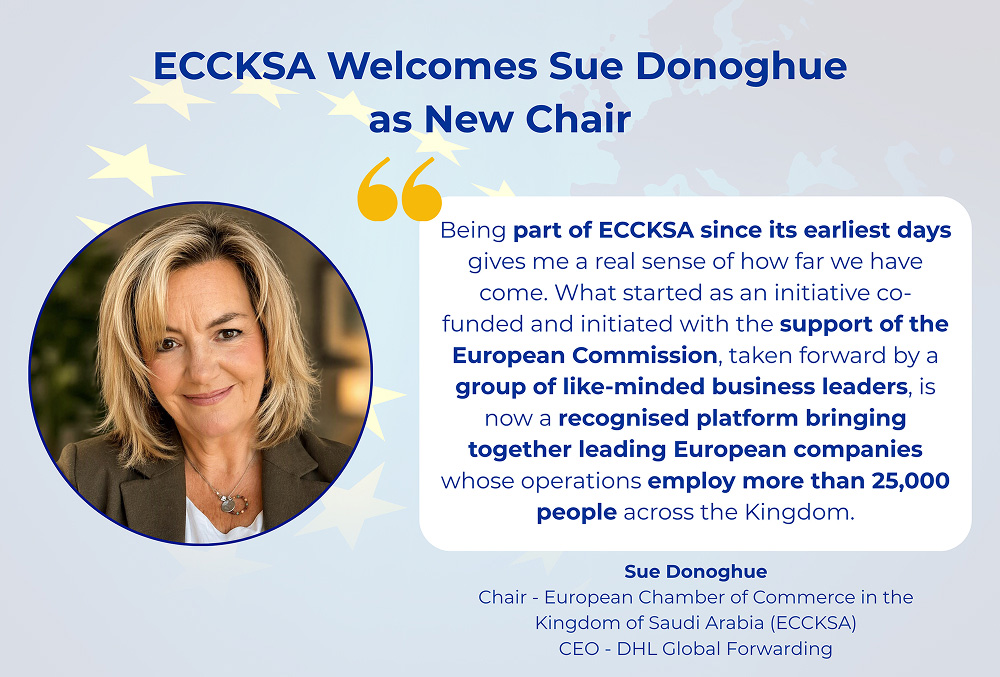
ECCKSA Board of Directors elects Sue Donoghue as New Chair
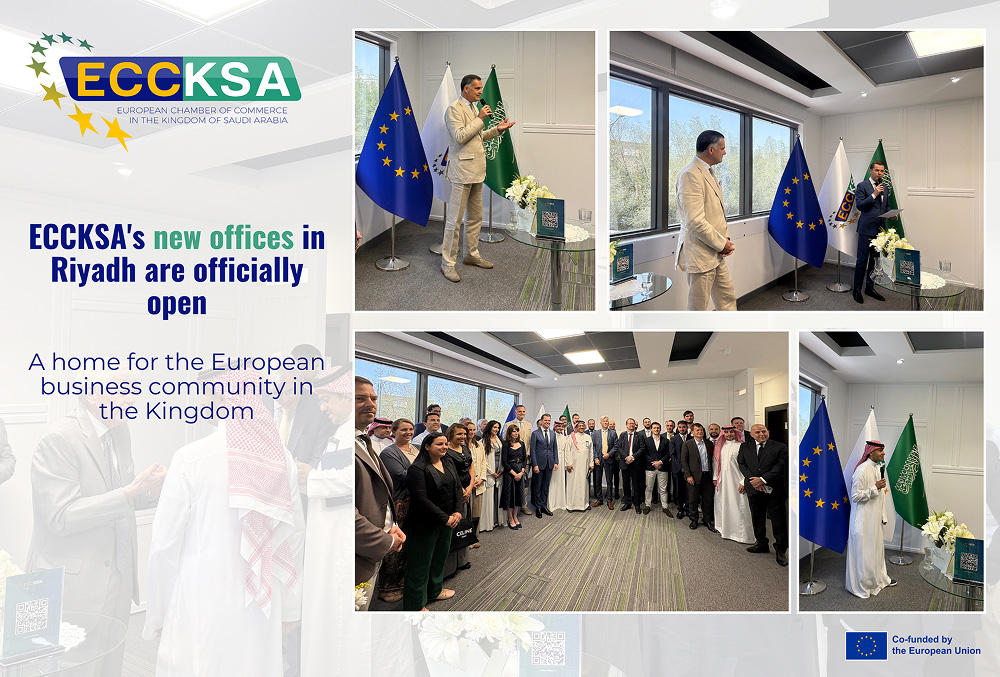
ECCKSA’s new offices in Riyadh are officially open



Membership
Committees
Events
News & Media
Publications
Other
About Us
Membership
Committees
Events
News & Media
Publications
Other