
Home » The Sports Industry in Saudi Arabia: A Strategic Engine of Transformation

Over the past decade, Saudi Arabia has undertaken one of the most ambitious economic transformation programmes in the contemporary world. Through its Vision 2030 framework, the Kingdom seeks to reduce its structural dependence on hydrocarbons while fostering a diversified and sustainable economic model. Within this broader transformation, the sports industry has emerged as a central pillar of national development, positioned at the intersection of economic diversification, social transformation, and global positioning.
This evolution is reflected in both public policy priorities and measurable socio-economic outcomes. Sports participation has risen from 13 percent in 2015 to approximately 48 percent in 2023, illustrating a profound shift in societal engagement with physical activity. At the same time, the multiplication of major sporting events, including Formula 1 races, international boxing competitions, esports tournaments, as well as the WTA Finals hosted in the Kingdom in recent years, has significantly enhanced Saudi Arabia’s global visibility and attractiveness. The attribution of the FIFA World Cup 2034 to Saudi Arabia further reinforces this dynamic and represents a key milestone in the Kingdom’s long term sports strategy.
Saudi Arabia is not merely investing in sport as an industry, but is actively constructing a new economic sector at the crossroads of entertainment, urban development, and digital innovation. The development of sport in the Kingdom is therefore best understood as a comprehensive, state-led transformation that integrates infrastructure, governance, and technology while creating long-term opportunities for international partners.
The expansion of the sports sector in Saudi Arabia is rooted in a centralised and strategic policy framework. Vision 2030 explicitly identifies sport as a key driver of economic diversification and quality of life improvement. The government initially set a target of increasing sports participation to 40 percent by 2030, a goal already surpassed, demonstrating both the speed and effectiveness of the reforms implemented.
At the core of this transformation lies the leadership of the Crown Prince, Mohammed bin Salman, who has integrated sport into the Kingdom’s broader economic and social agenda. Through the Public Investment Fund, Saudi Arabia has mobilised a sovereign wealth fund whose assets are estimated at approximately 1.15 trillion US dollars, making it one of the most powerful investment vehicles globally. The PIF has played a central role in structuring the sports ecosystem by financing domestic leagues, investing in international sports assets, and supporting the development of large scale infrastructure.
Beyond financial investment, the Saudi approach relies on a strong institutional architecture designed to coordinate the development of the sector. Public authorities, including the Ministry of Sport and specialised federations, play a central role in regulating, promoting, and structuring sports activities across the Kingdom. This institutional framework ensures coherence between public policies, private investment, and long-term strategic objectives, reinforcing the sustainability of the model.
This model reflects a deliberate strategy of accelerated market construction. Rather than relying on gradual private sector development, Saudi Arabia actively shapes the sports industry through strategic investment and long-term planning. In this regard, the Saudi model illustrates a form of state capitalism applied to sport, where public actors actively shape market dynamics rather than merely regulating them. Sport is thus evolving from a leisure activity into a strategic economic platform embedded within the Kingdom’s broader diversification strategy.
A key dimension of this transformation is the integration of gaming and esports. The National Gaming and Esports Strategy aims to generate over 13 billion dollars in economic output and create nearly 39,000 jobs by 2030. Saudi Arabia has also expanded its global footprint through investments in international gaming companies, reinforcing its ambition to become a leading hub in the digital entertainment economy. With more than 60 percent of its population under the age of 35, the Kingdom is particularly well positioned to capitalise on the rapid growth of this sector.
Saudi Arabia’s sports strategy is highly visible through its extensive hosting of international events. Over recent years, the Kingdom has rapidly positioned itself as a global destination for major competitions, including Formula 1 Grand Prix races in Jeddah, high-profile boxing events in Riyadh, and large-scale esports tournaments. These events serve both immediate economic purposes and longer-term strategic objectives.
From an economic perspective, large scale sporting events generate significant revenues through tourism, hospitality, and retail. Such events can stimulate GDP growth by attracting international visitors, increasing spending, and creating employment opportunities across multiple sectors. Saudi Arabia aims to increase tourism’s contribution to GDP to 10 percent by 2030, with sport playing a central role in achieving this objective. In this regard, the FIFA World Cup 2034 is expected to produce substantial macroeconomic effects, with estimates suggesting a GDP boost ranging between 9 and 14 billion US dollars, alongside the creation of up to 1.5 million jobs and the development of hundreds of thousands of hotel units to accommodate global demand. More broadly, economic modelling indicates that such mega events could contribute between 1 and 2 percent of annual GDP growth during the hosting year, while attracting several million international visitors and generating significant spillover effects across infrastructure, construction, and services.
The multiplication of international events has also contributed to the development of local capabilities in event organisation, logistics, and media production. This process of capacity building is essential for ensuring the long term sustainability of the sector, as it reduces reliance on external expertise and strengthens domestic know-how. In practice, this has led to the emergence and consolidation of a broad ecosystem of Saudi small and medium sized enterprises operating in fields such as event management, audiovisual production, digital marketing, security services, catering, and transport logistics. These developments benefit a wide range of domestic economic actors, including event service providers, media production companies, marketing agencies, private security firms, food and beverage operators, and mobility and logistics providers. In addition, large-scale sporting events generate important multiplier effects, stimulating demand in transport, hospitality, and retail while supporting the growth of small and medium sized enterprises, including hotel operators, travel agencies, restaurants, merchandising businesses, and urban mobility services.
This event driven model is complemented by ambitious infrastructure projects designed to embed sport within urban and territorial development. The Sports Boulevard project in Riyadh, spanning more than 135 kilometres, integrates sports facilities, cycling tracks, and green spaces into a continuous urban corridor, promoting both physical activity and environmental sustainability. More broadly, sporting events act as a catalyst for internal development by accelerating investments in transport, tourism, and urban infrastructure. In anticipation of future mega events, including the FIFA World Cup 2034, Saudi Arabia is expected to attract tens of millions of visitors over the coming decade, with projections suggesting that the tournament alone could draw more than five million international spectators. This has prompted large scale expansion in accommodation capacity, with plans to develop hundreds of thousands of additional hotel rooms across different price segments, including mid range and budget offerings, in order to support a more inclusive tourism model. At the same time, significant investments are being directed towards transport infrastructure, including the expansion of Riyadh Metro, upgrades to King Khalid International Airport, and the development of high speed rail connections linking major urban centres. These developments highlight how sport functions not only as an economic sector in itself but also as a structural driver of national development, reshaping urban landscapes, enhancing connectivity, and supporting the diversification of the Saudi economy.
Qiddiya represents another cornerstone of the Kingdom’s strategy. Expected to attract up to 17 million visitors annually, the project combines sport, entertainment, and tourism within a single large-scale development, generating significant economic activity and employment opportunities. Similarly, Soudah Peaks aims to diversify Saudi Arabia’s tourism offering through mountain sports and outdoor activities, with planned investments of approximately 7.7 billion dollars and a target of two million annual visitors.
Together, these projects illustrate a broader territorial transformation. They contribute to the creation of new economic zones, stimulate regional development, and reinforce Saudi Arabia’s attractiveness as a global destination. Sport thus becomes a structuring element of both economic and spatial development.
The transformation of Saudi Arabia’s sports industry is also reflected in the increasing internationalisation of its domestic market. The Saudi Pro League has undergone a significant upgrade, marked by the arrival of global football stars such as Cristiano Ronaldo and Karim Benzema. These high-profile transfers illustrate not only the attractiveness of the Saudi market, but also its capacity to integrate into global sports value chains.
The presence of internationally recognised athletes generates multiple economic and institutional spillovers. Broadcasting revenues have increased significantly, sponsorship deals have expanded, and global audiences have grown. At the same time, the arrival of experienced players facilitates knowledge transfer, improving training standards, management practices, and organisational efficiency within clubs and federations.
This strategy also reflects a broader repositioning of Saudi Arabia within the global sports economy. By attracting international talent, the Kingdom accelerates its integration into transnational sports networks and commercial ecosystems. In this context, sport functions as a vector of economic connectivity, linking domestic development with global flows of capital, talent, and media exposure.
Beyond elite sport, the sector contributes to significant social transformation. Women’s participation in sport has increased rapidly in recent years, supported by institutional reforms and policy initiatives. Athletes such as Rasha Al-Khamis, Mashael Alayed, and Wojdan Shaherkani illustrate the growing inclusiveness and diversification of the Saudi sports ecosystem.
The expansion of the sector also creates substantial opportunities for international companies, particularly European firms. The scale of ongoing projects generates demand across infrastructure, engineering, event management, media, and digital technologies. European companies benefit from a strong competitive advantage in high-value-added sectors, where their expertise aligns with Saudi Arabia’s investment priorities.
The development of gaming and esports further expands these opportunities. With a young and digitally connected population, Saudi Arabia represents one of the fastest-growing gaming markets globally. This creates opportunities in software development, immersive technologies, and content production, reinforcing the Kingdom’s position within the global sports and entertainment economy.
Saudi Arabia’s sports industry has become a central pillar of its economic transformation strategy. Through strong leadership, large-scale investment, and integrated planning, the Kingdom has successfully positioned sport as a driver of diversification, social development, and international engagement.
Ultimately, the Saudi experience demonstrates how sport can be leveraged not only as an economic sector, but as a transformative policy tool capable of reshaping societies, economies, and international positioning. As this transformation continues, Saudi Arabia is emerging not only as a growing market, but as a key hub within the global sports economy.
Figure: Invest Saudi Renewable Energy Brochure (MISA, 2024)
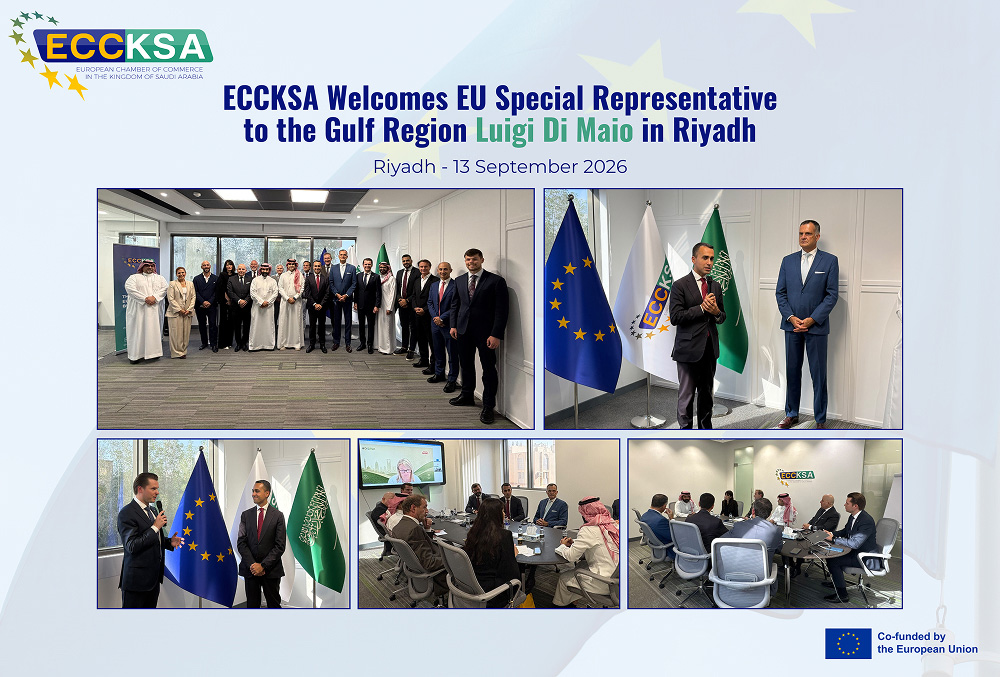
ECCKSA Welcomes EUSR for the Gulf Region H.E. Luigi Di Maio in Riyadh
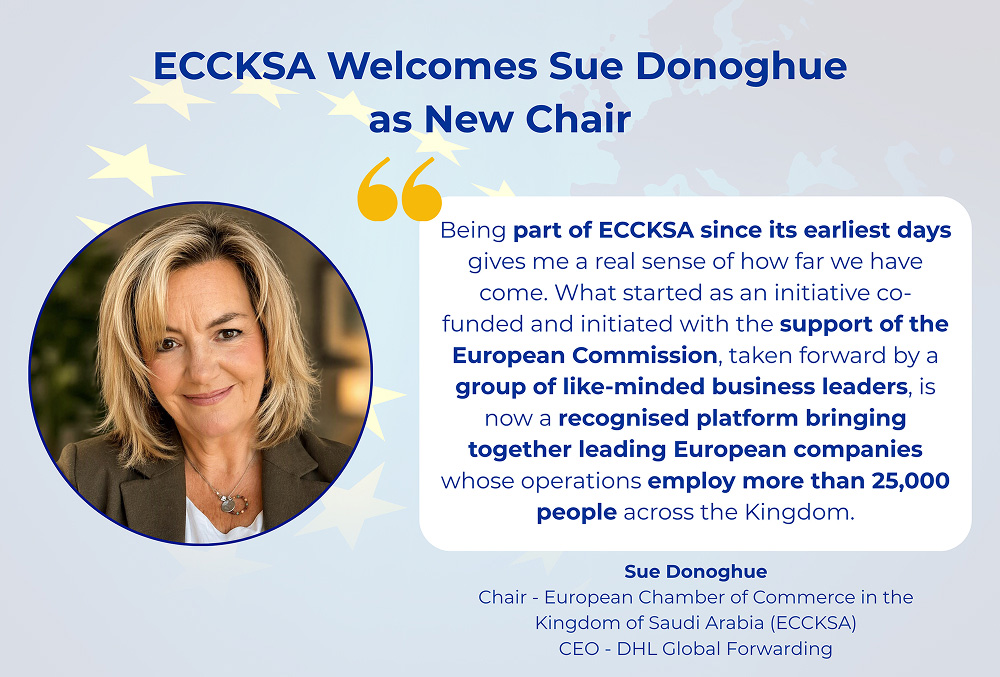
ECCKSA Board of Directors elects Sue Donoghue as New Chair



Membership
Committees
Events
News & Media
Publications
Other
About Us
Membership
Committees
Events
News & Media
Publications
Other