
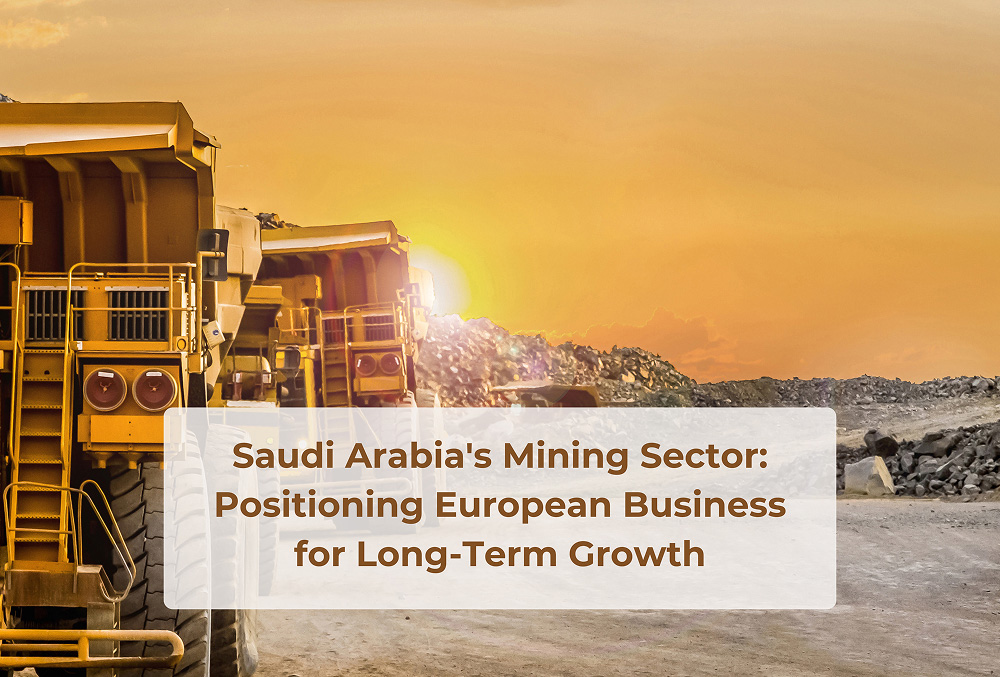
Home » Saudi Arabia’s Mining Sector: Positioning European Business for Long-Term Growth
Saudi Arabia’s mining sector merits close attention from European companies: the Kingdom is combining political backing, regulatory reform, project origination and international outreach in a manner that is creating investable opportunities across the mining value chain, well beyond headline ambition. For European industry, the sector is of particular interest where business strategies intersect with the European Union’s Critical Raw Materials Act (CRM Act) and RESourceEU, which seeks to secure more resilient, diversified and sustainable supply chains for the materials required for the green, digital and industrial transitions.
The Kingdom presents mining as the third pillar of its economy, alongside oil and petrochemicals, under Vision 2030. This framing is not limited to upstream extraction: Saudi policy increasingly centres on exploration, processing, refining, logistics and industrial localisation, with the aim of moving from resource endowment to integrated value creation. This evolution matters for European firms because it broadens the addressable market well beyond mine ownership and into engineering, technology, equipment, services, environmental performance, skills partnerships and downstream industrial cooperation.
Saudi Arabia has been exploring its mineral potential for decades, but the pace of activity has accelerated under Vision 2030. The Kingdom highlights a broad mineral base including gold, copper, zinc, phosphate, aluminium inputs and rare earth elements, and Saudi authorities cite a mineral resource endowment of around USD 2.5 trillion.
What has changed most materially since 2024 is the degree of state mobilisation behind the sector. Saudi authorities are pairing geological survey efforts with a faster licensing cycle, dedicated investor promotion and a strong signalling that mining is expected to contribute more meaningfully to GDP and industrial diversification. In March 2026, the Ministry of Industry and Mineral Resources issued 80 new mining licences, more than double the February total, illustrating both the volume of applications and the authorities’ determination to expand the project pipeline.
This regulatory pipeline has continued to expand into Q2 2026. In June, the Ministry of Industry and Mineral Resources qualified 24 local and international companies and consortiums for the tenth round of its exploration licensing competition, covering some 13,000 square kilometres of mineral-rich belts across the Medina, Mecca, Riyadh, Qassim and Hail regions, with significant deposits of gold, copper, silver, zinc and nickel. Notably, the qualified bidders are drawn predominantly from Asia-Pacific, the Gulf and other regions, a composition that underlines the scale of international interest already converging on the Kingdom’s mining sector and reinforces the case for a more coordinated European presence.
The policy intent is therefore clear: Saudi Arabia is looking for partners able to support exploration, operational efficiency, processing capacity, localisation and workforce development. For European companies, this makes the market more relevant in practice, provided they approach it as a long-term industrial partnership.
The strongest argument for European interest lies in the sector’s growing alignment with the EU’s Critical Raw Materials Act. The CRM Act is designed to improve the Union’s security of supply for critical and strategic raw materials by diversifying external sourcing, strengthening processing and recycling capacity, and reducing excessive dependence on a limited number of supplier countries. This effort has since been reinforced by the RESourceEU Action Plan, adopted by the European Commission to accelerate and amplify efforts to secure the EU’s supply of critical raw materials such as rare earth elements, cobalt and lithium. Building on the CRM Act, RESourceEU provides financing and concrete tools to protect European industry from geopolitical and price shocks, promote projects on critical raw materials in Europe and beyond, and partner with like-minded countries to diversify supply chains. For the European Commission, supply resilience is a matter of processing, refining, sustainability, traceability and long-term partnerships.
Saudi Arabia is increasingly positioning itself in precisely these spaces. The Kingdom has made critical raw materials a more explicit part of its diversification strategy, with growing attention to lithium, copper and rare earths in addition to its established strengths in phosphate and other minerals. More significantly, recent Saudi messaging suggests a strategic shift from acquiring minority stakes abroad towards building domestic processing and refining capabilities, particularly in segments relevant to clean technology supply chains. This shift is highly pertinent from a European perspective, as the CRM Act favours resilient value chains capable of supporting industrial offtake, responsible sourcing and strategic autonomy.
This convergence is no longer merely conceptual. During the Future Minerals Forum 2026 in Riyadh, the European Union and Saudi Arabia convened a high-level EU-KSA Business & Investment Dialogue focused specifically on advancing cooperation across critical raw materials value chains. The discussion brought together around 60 senior representatives from public authorities, industry and financial institutions, and was framed around the alignment between EU policies under the CRM Act and ResourceEU, and Saudi Arabia’s mining and industrial priorities. This development matters, as it suggests that Saudi mining could increasingly feature in EU policy discussions, alongside its commercial dimension, as one element within the Union’s wider external raw materials diplomacy.
The practical challenge for European stakeholders is therefore to move from dialogue to project-level engagement, particularly in areas where European firms can offer differentiated value: advanced exploration, mining equipment and services, process engineering, digitalisation, mine safety, low-impact technologies and training.
For European companies already present in Saudi Arabia, or considering market entry, the main opportunities are likely to emerge across the broader mining ecosystem rather than in extraction alone. Saudi policy increasingly favours integrated industrial development, which creates demand for technical and commercial partnerships in geoscience, drilling services, automation, remote operations, mineral processing, environmental monitoring, energy efficiency, logistics and capability-building.
European firms are well positioned in these segments. As Saudi Arabia seeks to improve its geological knowledge, upgrade operational capability and localise more value, European companies have a real edge to offer: they build to a high standard, run efficient operations, and meet the compliance and traceability requirements that internationally credible projects demand.
There is also a geopolitical and commercial rationale for earlier engagement. Other international actors, including the United States, Australia and a number of European countries, are already cultivating positions through ministerial exchanges, memoranda of understanding, business delegations and technical cooperation. A more structured EU-level engagement with the Saudi mining ecosystem could allow European companies to pool their strengths and negotiate from a position of scale rather than acting individually. Such coordination might also influence how project access, local partnerships and strategic positioning come to reflect the weight of European expertise in the sector.
For European companies, the commercial implication is straightforward: the most credible route into the sector is to run through long-term partnership models that combine technology transfer, local content, operational excellence and sustainability with a clear understanding of Saudi industrial policy.
Figure: Invest Saudi Renewable Energy Brochure (MISA, 2024)
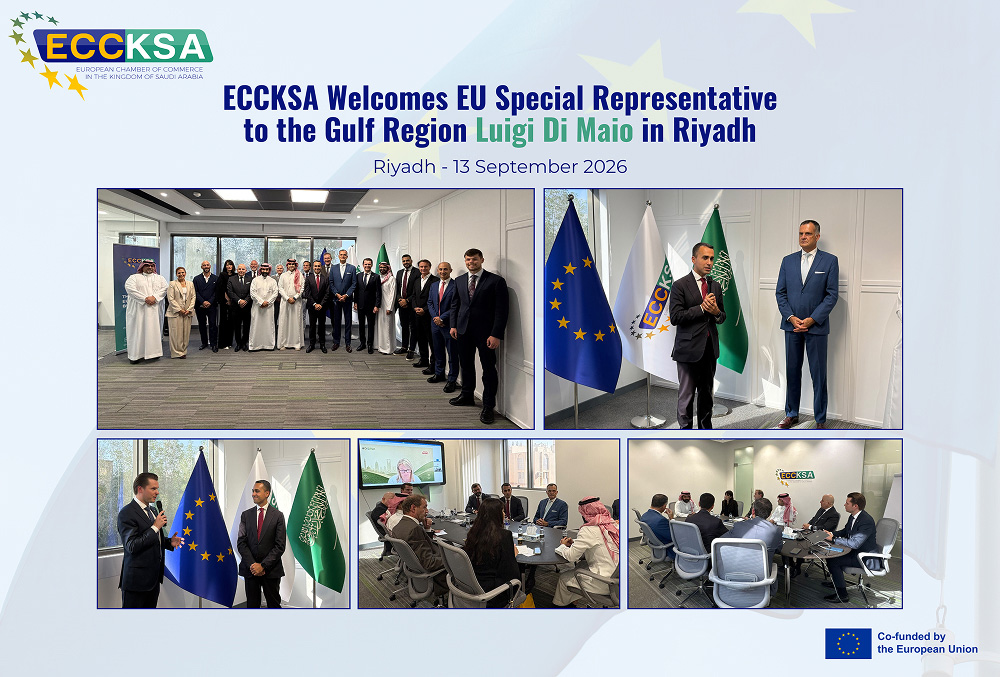
ECCKSA Welcomes EUSR for the Gulf Region H.E. Luigi Di Maio in Riyadh
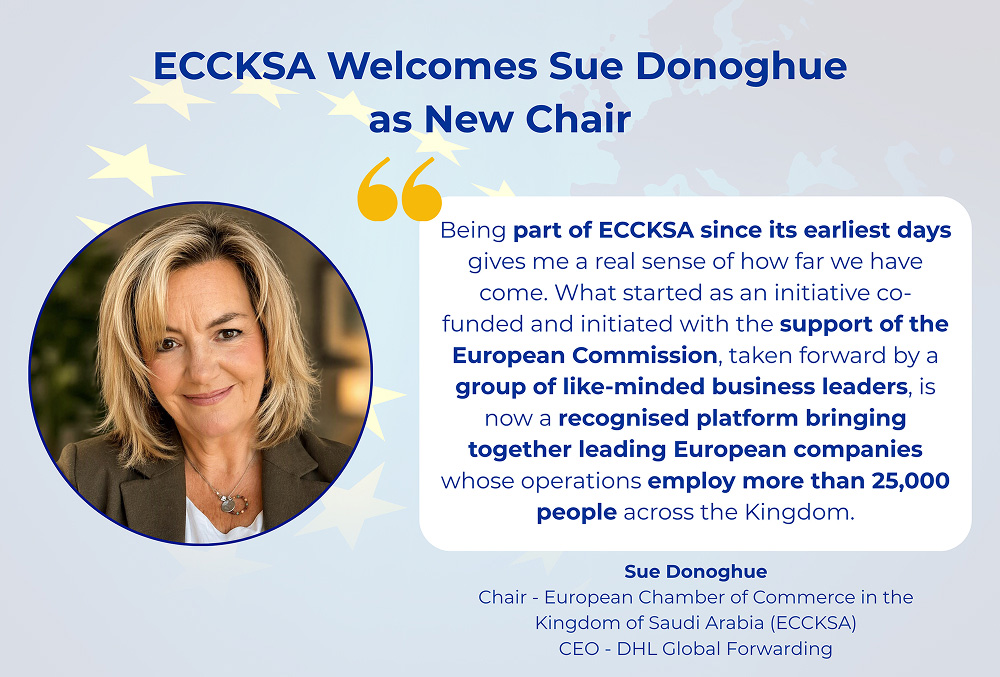
ECCKSA Board of Directors elects Sue Donoghue as New Chair



Membership
Committees
Events
News & Media
Publications
Other
About Us
Membership
Committees
Events
News & Media
Publications
Other