
Home » Saudi Arabia’s Water Sector: A Strategic Partnership Opportunity for European Expertise
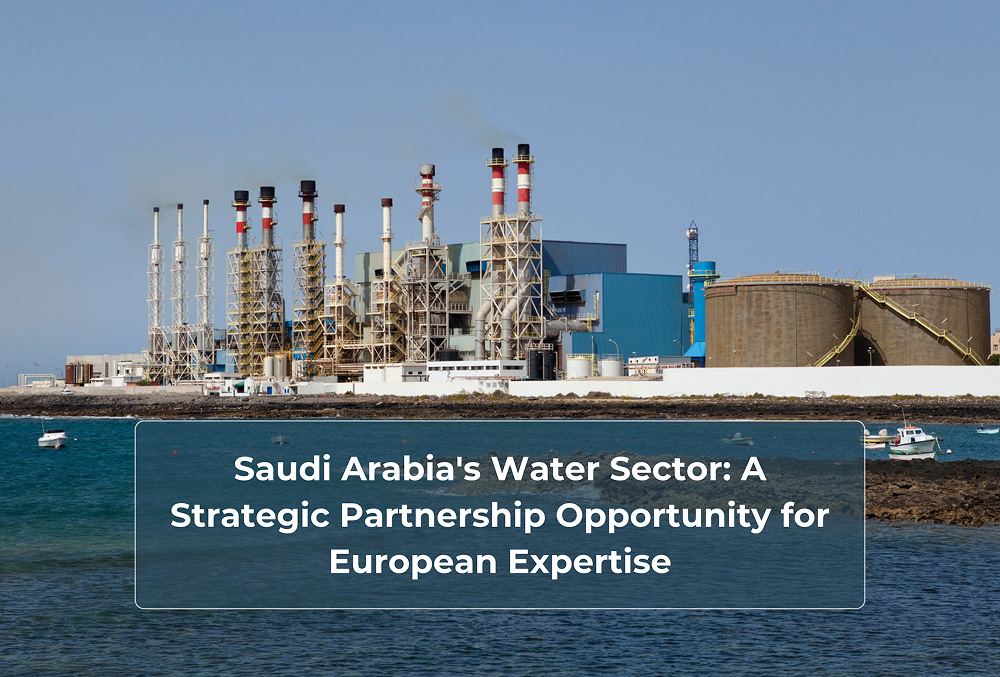
Saudi Arabia’s water sector is one in which European companies have already celebrated notable successes, and one that holds significant opportunities for the years ahead. The Kingdom has turned one of its most structural challenges into a field of global leadership, combining large-scale investment, institutional reform, a mature public-private partnership (PPP) model and a strong commitment to innovation. Saudi Arabia is today the world’s largest producer of desalinated water, and its water strategy is creating sustained, investable opportunities across the entire value chain, from desalination and transmission to wastewater treatment, reuse and digital network management.
For European industry, the sector is of particular interest because it sits at the intersection of two converging agendas. On the Saudi side, water security is a central component of Vision 2030 and of the Kingdom’s growing international role on water diplomacy. On the European side, the European Water Resilience Strategy, adopted by the Commission in June 2025, aims to build a competitive “water-smart” economy and to strengthen the EU’s international cooperation on water resilience. According to the Commission’s Communication on the European Water Resilience Strategy (COM(2025) 280), Europe accounts for 40% of all water technology patents globally, and operators from across the European Union have been trusted partners of the Kingdom for decades.
With no permanent rivers and limited renewable groundwater, Saudi Arabia has built one of the most advanced water supply systems in the world. According to official data cited in the National Transformation Program’s 2025 annual report, the Kingdom’s desalination capacity exceeded 16 million cubic metres per day by the end of 2025, up from 4.6 million in 2016. Over the same period, more than 3.7 million metres of transmission and distribution lines have been installed, and water supply services now reach more than 27 million beneficiaries.
This expansion has been accompanied by a strong focus on performance. Saudi plants hold several Guinness World Records, including the lowest energy consumption for a desalination plant at Shuaiba Phase 5 (2.34 kWh per cubic metre) and record production capacity on a compact footprint at Al-Khobar Phase II. The Kingdom has also opened the Rabigh Oasis Water Research and Innovation Facility, presented as the world’s largest water research facility, to serve as a national hub for applied innovation.
Saudi Arabia has equally positioned itself as a convening power on global water issues. Riyadh hosted the One Water Summit in December 2024, co-organised by France, Kazakhstan and the World Bank in partnership with the Kingdom, on the margins of COP16 on desertification. The Kingdom has since launched the Global Water Organization, headquartered in Riyadh, whose founding members include two EU Member States, Spain and Greece. Looking ahead, Riyadh will host the 11th World Water Forum in March 2027, the sector’s largest international gathering, which will offer a natural platform for EU-Saudi dialogue and for European companies to showcase their solutions.
What distinguishes the Saudi water sector is its institutional architecture and the central role it gives to the private sector. Policy is set by the Ministry of Environment, Water and Agriculture (MEWA), while the Saudi Water Authority oversees production and the National Water Company (NWC) manages distribution and wastewater services across the Kingdom’s regional clusters.
At the heart of the PPP model is Sharakat, the new name adopted in February 2026 by the Saudi Water Partnership Company (SWPC) to reflect its expanding mandate. As principal offtaker of all water in the Kingdom since 2017, Sharakat procures independent water projects (IWPs), independent sewage treatment plants (ISTPs), transmission pipelines, small-scale plants and strategic reservoirs. The total investment value of its current projects exceeds SAR 56 billion (around USD 14.9 billion).
This model is embedded in a wider national ambition. The National Privatisation Strategy, steered by the National Center for Privatization & PPP (NCP), targets more than 220 PPP contracts by 2030 and over SAR 240 billion (USD 64 billion) in private capital investment across sectors. Water is one of the most advanced segments of this programme, with standardised contracts, long-term offtake agreements and a predictable tendering calendar that international investors and lenders know well.
The Kingdom is also continuing the gradual reform of utility pricing. On 25 October 2026, the National Water Company and Saudi Energy announced adjusted water, wastewater and electricity tariffs taking effect from 1 January 2027, in line with the governance procedures for adjusting energy and water prices. This reform is likely to reinforce the long-term sustainability of the sector and encourage more efficient water use, creating additional demand for metering, network management and water efficiency solutions.
The sector’s momentum is visible in the breadth of its pipeline. According to MEED Projects, Sharakat has more than USD 11 billion of PPP projects in preparation, spanning the full water cycle rather than desalination alone. Recent and ongoing procurements illustrate this diversity: the 859-kilometre Riyadh-Qassim independent water transmission pipeline, the Arana ISTP, and the Riyadh East ISTP, designed to treat 200,000 cubic metres per day in a first phase, expandable to 400,000.
International interest in this pipeline is strong and broad-based. Under its second pre-qualification programme, SWPC pre-qualified 50 developers for IWPs and 63 for ISTPs, who will receive requests for proposals directly for future projects. Companies from a wide range of EU Member States feature prominently on these lists, giving European industry a solid basis from which to compete for the next generation of projects.
Beyond municipal water, demand is also growing on the industrial side. Large industrial and mining players are investing in water treatment, reuse and zero liquid discharge solutions to secure their operations and meet sustainability objectives, creating a second, complementary market for European technology providers and operators.
The technological direction of the Saudi water sector closely matches European strengths. The Kingdom has largely shifted from thermal desalination towards reverse osmosis, which requires significantly less energy, and is increasingly integrating renewable power into its plants. The Jubail 3B independent water project, with a capacity of 570,000 cubic metres per day and a 61 MWp on-site solar facility, illustrates this combination of scale and sustainability.
The next frontier lies in circularity. Treated wastewater reuse, industrial water recycling, brine management and the recovery of materials from industrial effluent are becoming priorities for both public authorities and industrial groups. These are precisely the areas highlighted in the EU’s Water Resilience Strategy, which promotes water efficiency, digitalisation, including the use of artificial intelligence in water management, and a competitive European water industry, supported by an European Investment Bank Water Programme of over EUR 15 billion for 2025-2027.
Digital solutions represent a further area of convergence. Smart metering, leak detection, network modelling and predictive maintenance are central to improving the performance of distribution networks, an area where European operators bring extensive expertise developed in networks across Europe and worldwide.
European companies have contributed to the development of the Saudi water sector for decades, from flagship desalination plants to the operation of water services for millions inhabitants and industrial water reuse. Looking ahead, opportunities extend well beyond large desalination tenders, across engineering, treatment technologies, energy efficiency, wastewater and reuse, digital network management and capability-building, where European firms bring proven technologies, long PPP experience and high environmental standards.
The continued roll-out of Sharakat’s pipeline and the 11th World Water Forum in Riyadh in March 2027 offer timely opportunities to deepen this engagement. A coordinated European presence, built on long-term partnerships combining technology, local content and sustainability, would align closely with the Kingdom’s ambition to build one of the world’s most efficient and resilient water systems. Reflecting this momentum, ECCKSA is developing water as a dedicated vertical, bringing together European companies active in the sector.
Figure: Invest Saudi Renewable Energy Brochure (MISA, 2024)
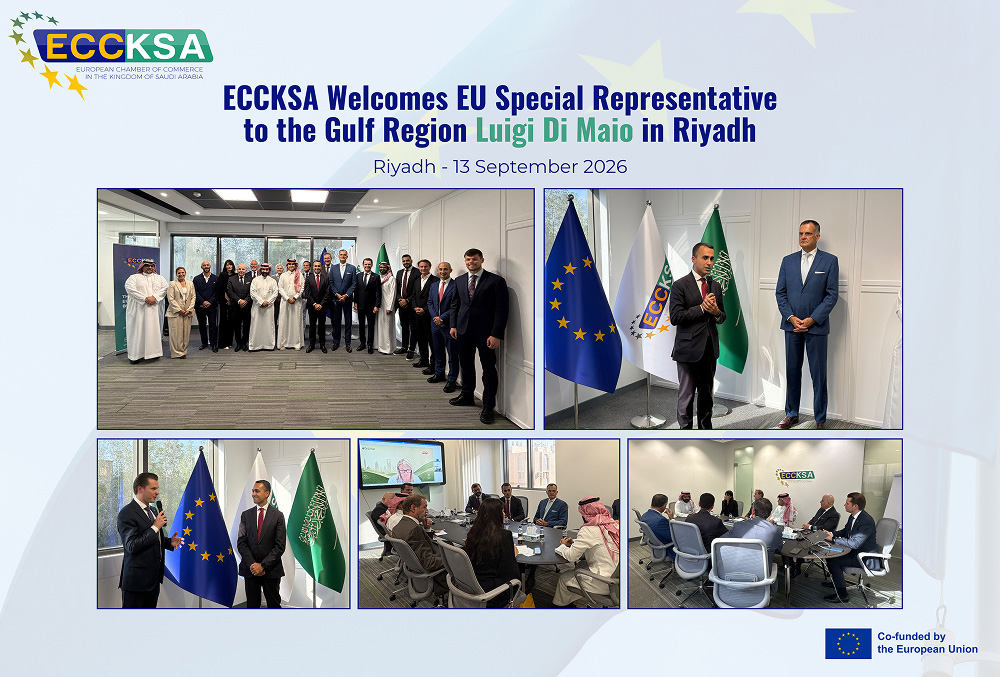
ECCKSA Welcomes EUSR for the Gulf Region H.E. Luigi Di Maio in Riyadh
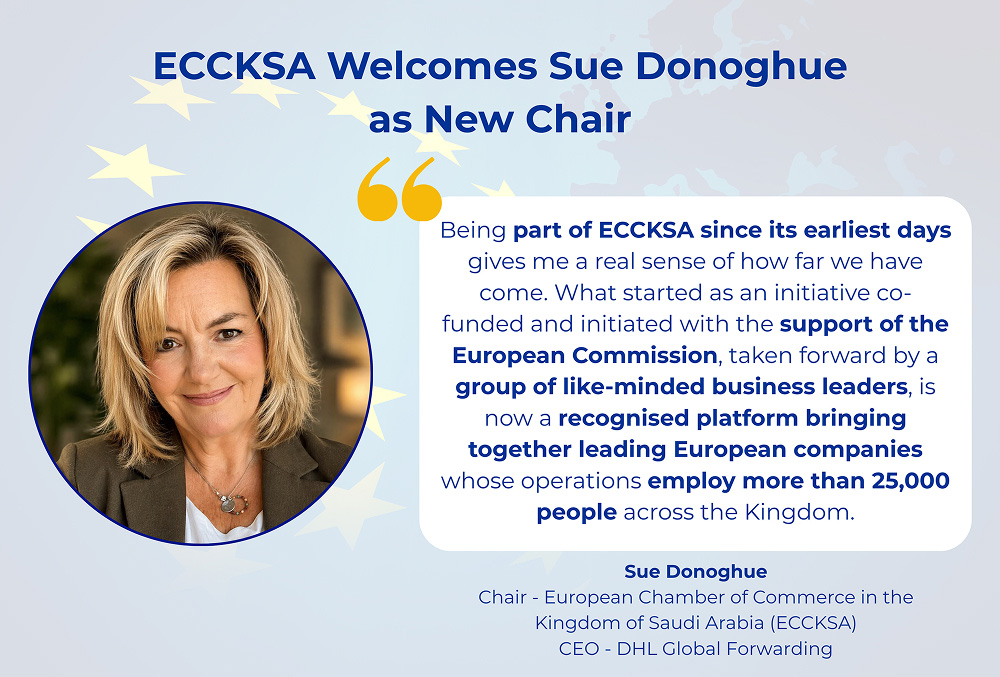
ECCKSA Board of Directors elects Sue Donoghue as New Chair



Membership
Committees
Events
News & Media
Publications
Other
About Us
Membership
Committees
Events
News & Media
Publications
Other